Here is my attempt to explain my thesis using only the ten hundred most used words in English. I used the marvellous Up-Goer Five text editor by Theo Sanderson inspired by XKCD.
When you cool a water-like stuff, you get a hard stuff. In many hard
stuffs, the bits are lining straight. But in other hard stuffs there is
no straight line.
The hard stuff that make the walls of a can do have straight lines.
Because of those lines you can make the can smaller by pushing down on
it without breaking it into pieces. Window glass has no line, so if you
push it too strong it will break into pieces, but if you push it just a
little bit it is harder that a can, you can't make it smaller by pushing
it. Having no lines makes hard stuffs even harder.
Also, that is because there is no straight line in window glass that the
light can get through, straight lines stop light or make it funny.
Sometimes
you want very very hard stuffs, or see-through hard stuffs, so you
don't want lines in it. Sometimes you want hard stuffs that you can
push hard without breaking, or hard stuff that stop light or make it
funny, so you need lines. It is very important to know how to make lines
or not to make lines.
The problem is: no one knows how to control the lines. Also, no one knows why stuffs without lines can be hard at all!
Water-like
stuffs have no lines and they are not hard. So it is not lines that
decide if a stuff is hard or not. What decides then? People had this
idea: if bits of stuff group together they become hard. If you stick
those groups together, you can make hard stuff. You can group bits of stuff by five, that makes them very hard. You can also makes groups of six which are quite hard.
By
the way, if you make groups of six, it is easy to make lines out of it,
so you have made a hard stuff with lines. But if you make groups of
five, you can't make lines, so you have made a hard stuff without lines.
Is
this idea right? To know this, I looked at stuffs that are still
water-like but cold enough to become hard. If I cool down a little more,
they become hard stuff without line. These stuffs are in between
water-like stuff and no-line-hard stuff. Actually they are a little bit hard.
People found that some parts of it are slow and some parts are fast. The
colder you get, the larger those fast and slow parts become.
What
people think, it that hard parts must be slow. So I looked if there was
groups of five or groups of six, there was, and if they are slow or
fast. I found that both kind of groups are slow, but groups of six are
much slower than groups of five. This is a surprise! Also, I found that
the more I cool down, the more groups of six I see. I don't see more
groups of five. So it is the groups of six that are important to make
the stuff hard, not the groups of five.
So, what makes stuffs
without lines hard is not groups that can't make lines. It is groups
that could make lines but there is something in the way. Maybe that is
the groups of five that get in the way.
Showing posts with label glass. Show all posts
Showing posts with label glass. Show all posts
Sunday, February 10, 2013

Sunday, November 27, 2011
Seminar and meetings in France
I'm giving a seminar in the Ecole Normale Supérieure (ENS) in Lyon, France the 6th of December. Just after that I'll be in Paris for 2 consecutive meetings:
- The French-Japanese meeting on Jamming, Glasses and Phase transitions
- Unifying Concepts in Glass Physics V, where I will be presenting a poster.
A link between local structural ordering and slow dynamics has recently attracted much attention from the context of the origin of glassy slow dynamics [1, 2]. There have been a few candidates for such structural order [3, 4], icosahedral order, exotic amorphous order, and crystal-like order. Each type of order is linked to a different scenario of glass transition. Thus, revealing the order responsible for slow dynamics is crucial for our understanding of the glass transition. Here we experimentally access local structural order in polydisperse hard spheres by its particle-level observation with confocal microscopy. We identify the key structures as icosahedral and face-centred-cubic(fcc)-like order, excluding any other simple local symmetry. We find that both types of order are statistically associated with slow particles. However, when approaching the glass transition, the icosahedral order does not grow in size whereas crystal-like structures grow. It is the latter that governs the dynamics and is linked to dynamic heterogeneity. This questions the direct roles of the icosahedral ordering in glassy slow dynamics and stresses the importance of the structural order compatible with the avoided first order transition, crystallization. Our finding also suggests that the growing lengthscale of structural order is essential for the slowing down of dynamics and the nonlocal cooperativity in particle motion.
References
- Cavagna, A. Supercooled liquids for pedestrians. Physics Reports 476, 51124, 2009.
- Berthier, L. & Biroli, G. Theoretical perspective on the glass transition and amorphous materials. Rev. Mod. Phys. 83, 587, 2011.
- Steinhardt, P., Nelson, D. & Ronchetti, M. Bond-orientational order in liquids and glasses. Phys. Rev. B 28, 784805, 1983.
- Tarjus, G., Kivelson, S. A., Nussinov, Z. & Viot, P. The frustration-based approach of super-cooled liquids and the glass transition: a review and critical assessment. J. Phys.: Condens. Matter 17, R114R1182, 2005.
- Lubchenko, V. & Wolynes, P. Theory of structural glasses and supercooled liquids. Annu. Rev. Phys. Chem. 58, 235266, 2007.
- Tanaka, H., Kawasaki, T., Shintani, H. & Watanabe, K. Critical-like behaviour of glass-forming liquids. Nature materials 9, 324Ð31, 2010.
 |
| Reconstruction from confocal microscopy coordinates. Only structured particles are shown for clarity. |
Friday, November 11, 2011
Kanto softmatter talk
A busy week is ending ... almost. I give a talk tomorrow at a workshop (yes, a Saturday !), on Monday I submit a research proposal to be paid from April. And after that I will have to work again on a paper that has been rejected.
Tomorrow is the kanto softmatter workshop, a very local meeting for the soft matter labs around Tokyo. Talks are only given by young researchers, not by big names. That is why I have an opportunity to talk. In larger conferences until now I only got poster presentations. Well, there is no bed of roses.
I will talk about my thesis work, in particular the content of the paper that was rejected: what are the local structures playing a role in a model of glass transition and which one is more important than the other. The answer is rather surprising. A glass is amorphous, so most people think that a glass is the opposite of a crystal. Therefore if glass has a structure this structure must be very different and incompatible with the crystal symmetry. That's why icosahedral order is often exhibited as a typical glass order.
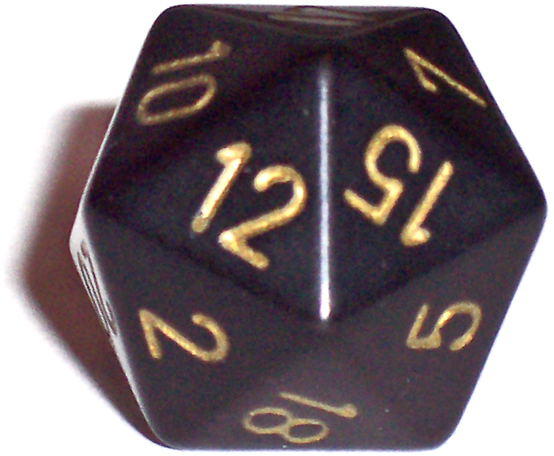
A icosahedron is a solid with 20 identical faces. Like this dice used in Dungeons&Dragons.
As you can see, there are pentagons everywhere in that structure: icosahedron has 5-fold symmetries. The problem with five-fold symmetry is that it cannot pave space (at least in 2D and 3D). Try to pack them together and you will always have gaps.
However, the icosahedron is very dense and often maximises locally the interaction energy between the particles. Icosahedral order is locally the best structure, so it forms easily in a dense liquid, but cannot spread. That is what is called frustration.
What one can image in a supercooled liquid is icosahedral bits, probably forming a sort of network or fractal, and total disorder in the gaps. The icosahedral structure is stable, so is moves very slowly and slows the overall dynamics. If we are still in the liquid a given icosahedral bit will eventually disappears while order is formed elsewhere, but in the glass even that rearrangement is forbidden, too costly in energy to append in a reasonable time, so everything is stuck. Here is an explanation of the glass transition.
Another explanation (advertise by my boss, so my judgement may be biased) is that a supercooled liquid is by definition metastable to the crystal, so the liquids "wants" to become a crystal. Things are getting in the way (like icosahedron for example) so the crystal is not formed. However, there are stuffs in the supercooled liquid that look like a little bit like crystals. Not very healthy crystal if you pass me the expression; hunchbacks, twisted legs, broken faces, no arms ... still if you look close enough the local structure is closer to the crystal than anything else.
Once you have a method to detect these crystal-like stuffs, which has been done in an handful of models, you discover that they are slower than the rest of the liquid and that their size is growing when you get closer to the glass transition. Paradoxically isn't it the crystal that is responsible for the slowing down to the glass ?
Who is slowing down the system ? The locally favoured structure of the fluid or the influence of the crystal ? To answer this question I used a system that has independently icosahedra and crystal-like structures. In a few systems, people have found very slow icosahedral structures and some of them exhibited it as the proof that liquid order was the culprit. However others remarked that the "crystal" in these systems actually contains some icosahedral motifs. For example if the "crystal" is in fact a quasicrystal with five-fold symmetry, you cannot tell if the icosahedra that you see in the supercooled liquid come from the locally favoured structure of the liquid or as crystal-like stuff.
To avoid that confusion, my system has a well known crystal of face centered cubic structure, without a glimpse of icosahedron in it. In addition, icosahedral order is locally favoured. In that situation, no mistake possible, the slower structure wins.
And at the end, I found that the icosahedral bits play very little role in the slowing down, the crystal-like bits are doing all the slowing work. Of course Icosahedral order plays a role : it is frustrating the crystallisation, and that is thanks to that frustration that we are able to supercool the liquid in the first place. However, that is the influence of the crystal that governs the slowing down and thus the glass transition.
Details in the paper to come ... when accepted.
Tomorrow is the kanto softmatter workshop, a very local meeting for the soft matter labs around Tokyo. Talks are only given by young researchers, not by big names. That is why I have an opportunity to talk. In larger conferences until now I only got poster presentations. Well, there is no bed of roses.
I will talk about my thesis work, in particular the content of the paper that was rejected: what are the local structures playing a role in a model of glass transition and which one is more important than the other. The answer is rather surprising. A glass is amorphous, so most people think that a glass is the opposite of a crystal. Therefore if glass has a structure this structure must be very different and incompatible with the crystal symmetry. That's why icosahedral order is often exhibited as a typical glass order.
A icosahedron is a solid with 20 identical faces. Like this dice used in Dungeons&Dragons.
 |
| via Wikimedia |
 |
| 13 particles forming a perfect icosahedron, from my thesis |
 |
| By JF Sadoc via Wikimedia |
However, the icosahedron is very dense and often maximises locally the interaction energy between the particles. Icosahedral order is locally the best structure, so it forms easily in a dense liquid, but cannot spread. That is what is called frustration.
What one can image in a supercooled liquid is icosahedral bits, probably forming a sort of network or fractal, and total disorder in the gaps. The icosahedral structure is stable, so is moves very slowly and slows the overall dynamics. If we are still in the liquid a given icosahedral bit will eventually disappears while order is formed elsewhere, but in the glass even that rearrangement is forbidden, too costly in energy to append in a reasonable time, so everything is stuck. Here is an explanation of the glass transition.
Another explanation (advertise by my boss, so my judgement may be biased) is that a supercooled liquid is by definition metastable to the crystal, so the liquids "wants" to become a crystal. Things are getting in the way (like icosahedron for example) so the crystal is not formed. However, there are stuffs in the supercooled liquid that look like a little bit like crystals. Not very healthy crystal if you pass me the expression; hunchbacks, twisted legs, broken faces, no arms ... still if you look close enough the local structure is closer to the crystal than anything else.
 |
| a) displacements b) crystalline order and c) number of neighbours in a 2D shaken granular supercooled fluid. From Keiji Watanabe and Hajime Tanaka, Physical Review Letters (2008). |
Who is slowing down the system ? The locally favoured structure of the fluid or the influence of the crystal ? To answer this question I used a system that has independently icosahedra and crystal-like structures. In a few systems, people have found very slow icosahedral structures and some of them exhibited it as the proof that liquid order was the culprit. However others remarked that the "crystal" in these systems actually contains some icosahedral motifs. For example if the "crystal" is in fact a quasicrystal with five-fold symmetry, you cannot tell if the icosahedra that you see in the supercooled liquid come from the locally favoured structure of the liquid or as crystal-like stuff.
 |
| A Frank-Kasper phase, which is a crystal containing icosahedra (large blue spheres). From the Trebin lab in the university of Stuttgart. |
 |
| A quasicrystal with icosahedral symmetry, via Wikimedia |
To avoid that confusion, my system has a well known crystal of face centered cubic structure, without a glimpse of icosahedron in it. In addition, icosahedral order is locally favoured. In that situation, no mistake possible, the slower structure wins.
And at the end, I found that the icosahedral bits play very little role in the slowing down, the crystal-like bits are doing all the slowing work. Of course Icosahedral order plays a role : it is frustrating the crystallisation, and that is thanks to that frustration that we are able to supercool the liquid in the first place. However, that is the influence of the crystal that governs the slowing down and thus the glass transition.
Details in the paper to come ... when accepted.
Thursday, October 27, 2011
Ultra-stable glasses
A way to prepare in an afternoon a glass as stable as if it was aged during centuries. That's what has discovered the group of Mark Ediger in the university of Wisconsin (USA).
They first described the method in Science back in 2007. The idea is to deposit vapour of the glass-former on a substrate about 50K colder than the glass transition temperature T_g. When you melt this glass, you need much more energy than when you melt a usual glass. It means that the vapour-deposited glass is more stable.
The usual way to prepare a glass is to cool down a liquid below it's crystallisation temperature, but avoiding the crystallisation. You then have a supercooled liquid, in metastable equilibrium. If you cool it further, the liquid becomes slower and slower, more and more viscous, until you cannot tell at all if it flows or not. And by definition, a material than does not flow is a solid. Here we have a solid that is not a crystal and we call it a glass.
Contrary to the supercooled liquid, the glass is not in equilibrium. Its properties (hardness, energy, ...) depends on its history and not only on the temperature, pressure, etc. For example if you try to deform a glass 10 hours after the quench, it will deform less than if you try immediately after the quench. This is called aging. Old guys are getting tougher and tougher, less and less prone to change, that is the same for glasses.
Another way of measuring aging is to melt the glass back to supercooled liquid while measuring the heat flux you need to do so. This method is called Differential Scanning Calorimetry (DSC). You then have a measure of the heat capacity (how much energy needed to raise the temperature of 1K) function of temperature. If you integrate that, you have the enthalpy.
So let's prepare a glass the usual way : cooling the liquid below it's glass transition temperature (let's say T_g-50K) and melt it again immediately in the DSC. This is our reference, the black curve of the graph below. Now let's do it again, but we let it wait 8 hours in the cold before melting it (green curve). As you can see, the enthalpy has lower than the reference. If we wait longer, the enthalpy will be even lower, but not that much ; we need to wait much longer (days) to see a significant shift down. Aging is slower and slower in glasses (contrary to humans). It means that if we want an even more stable glass, we must wait years, decades, centuries ... which is impractical.
Here comes Swallen, Kearns, Mapes, Kim, McMahon, Ediger, Wu, Yu, Satija and Sushil (yes, I cite them all). They do not cool the glass to T_g-50K, they form it at this temperature. Vapour of the glass former is introduced progressively in the DSC chamber so that it gets deposited on a plate. If you want, the glass is formed layer by layer (even if defining a "layer" of an amorphous material is tricky). The glass grows at a rate of a few nanometres per seconds (you would need a month to deposit 1 cm of glass).
When you heat that vapour-deposited glass, you obtain the blue curve that is much lower than the conventional glasses. The authors estimate to 40 years the time needed to age a glass to that stability. More recently they got to 4000 years of equivalent aging by tuning the deposition rate and temperature.
Why ? It is obvious that the molecules were able to arrange themselves in a better way. The scenario proposed by the authors is that a given molecule has a good deal of time (1s is tremendously long at the molecular level) between the moment it gets deposited on the surface and the moment when other molecules come sitting on top of it. In that interval, the molecule is relatively mobile on the surface and can find the best way to fit on it, the most stable arrangement. It is a bit like a Tetris at level 1: you have time to think where to put the next block, to slide it where it fits best.
How general is that phenomenon ? Well, they used only two quite complicated molecules (TNB and Indometacin) that may have quite strange phase behaviours, like liquid-liquid phase transition (has they point out in a more recent paper) and thus the ultra-stable glass phenomenon may not be general. However to my knowledge the vapour deposition trick has not been tried in simpler models of glass former like sticky spheres, polydispersed Lennard-Jones or silicon. It would be interesting to look at the Tetris game at particle level.
They first described the method in Science back in 2007. The idea is to deposit vapour of the glass-former on a substrate about 50K colder than the glass transition temperature T_g. When you melt this glass, you need much more energy than when you melt a usual glass. It means that the vapour-deposited glass is more stable.
 |
| Schematic view of the glass transition |
The usual way to prepare a glass is to cool down a liquid below it's crystallisation temperature, but avoiding the crystallisation. You then have a supercooled liquid, in metastable equilibrium. If you cool it further, the liquid becomes slower and slower, more and more viscous, until you cannot tell at all if it flows or not. And by definition, a material than does not flow is a solid. Here we have a solid that is not a crystal and we call it a glass.
Contrary to the supercooled liquid, the glass is not in equilibrium. Its properties (hardness, energy, ...) depends on its history and not only on the temperature, pressure, etc. For example if you try to deform a glass 10 hours after the quench, it will deform less than if you try immediately after the quench. This is called aging. Old guys are getting tougher and tougher, less and less prone to change, that is the same for glasses.
Another way of measuring aging is to melt the glass back to supercooled liquid while measuring the heat flux you need to do so. This method is called Differential Scanning Calorimetry (DSC). You then have a measure of the heat capacity (how much energy needed to raise the temperature of 1K) function of temperature. If you integrate that, you have the enthalpy.
So let's prepare a glass the usual way : cooling the liquid below it's glass transition temperature (let's say T_g-50K) and melt it again immediately in the DSC. This is our reference, the black curve of the graph below. Now let's do it again, but we let it wait 8 hours in the cold before melting it (green curve). As you can see, the enthalpy has lower than the reference. If we wait longer, the enthalpy will be even lower, but not that much ; we need to wait much longer (days) to see a significant shift down. Aging is slower and slower in glasses (contrary to humans). It means that if we want an even more stable glass, we must wait years, decades, centuries ... which is impractical.
 |
| Aging in a DSC experiment |
Here comes Swallen, Kearns, Mapes, Kim, McMahon, Ediger, Wu, Yu, Satija and Sushil (yes, I cite them all). They do not cool the glass to T_g-50K, they form it at this temperature. Vapour of the glass former is introduced progressively in the DSC chamber so that it gets deposited on a plate. If you want, the glass is formed layer by layer (even if defining a "layer" of an amorphous material is tricky). The glass grows at a rate of a few nanometres per seconds (you would need a month to deposit 1 cm of glass).
 |
| Vapor deposition of TNB |
When you heat that vapour-deposited glass, you obtain the blue curve that is much lower than the conventional glasses. The authors estimate to 40 years the time needed to age a glass to that stability. More recently they got to 4000 years of equivalent aging by tuning the deposition rate and temperature.
 |
| From Swallen et al., Science (New York, N.Y.) 315, 353-6 (2007). |
Why ? It is obvious that the molecules were able to arrange themselves in a better way. The scenario proposed by the authors is that a given molecule has a good deal of time (1s is tremendously long at the molecular level) between the moment it gets deposited on the surface and the moment when other molecules come sitting on top of it. In that interval, the molecule is relatively mobile on the surface and can find the best way to fit on it, the most stable arrangement. It is a bit like a Tetris at level 1: you have time to think where to put the next block, to slide it where it fits best.
How general is that phenomenon ? Well, they used only two quite complicated molecules (TNB and Indometacin) that may have quite strange phase behaviours, like liquid-liquid phase transition (has they point out in a more recent paper) and thus the ultra-stable glass phenomenon may not be general. However to my knowledge the vapour deposition trick has not been tried in simpler models of glass former like sticky spheres, polydispersed Lennard-Jones or silicon. It would be interesting to look at the Tetris game at particle level.
Subscribe to:
Posts (Atom)