Showing posts with label Tanaka lab. Show all posts

Tuesday, February 9, 2016

Layered cake and floating crystals

Mille crepe. By Laitr Keiows - Own work, CC BY-SA 3.0,


The soil we stand on is like a mille crepe, a layered cake made by the slow deposition of solid matter on an ocean bottom, each era adding a layer of a different nature. The process that makes particles even slightly denser than water settle down is called sedimentation.

A particle is pulled down by gravity, slowed down by the viscosity of the solvent. It also gets kicked randomly by the atoms around. For a large and heavy particle like a canon ball this random motion is negligible and the particle sediment to the bottom. For a small and almost buoyant particle like a protein, this random motion dominates and the particle diffuses in any direction. In between we have the so called sedimentation-diffusion equilibrium. Particles settle down, but also diffuse up, and we observe that the concentration of particles changes depending on height. At the bottom we count more particles than at the top. This is what we call a density profile.

Equilibrium density profiles are a great tool for physicist. By measuring them, you can learn how your particles behave as a system. For example, if you observe a density that decreases exponentially with altitude, you known that the suspension behaves like an "ideal gas", which means that the particles almost do not interact. That's more or less the density profile of the gases in the atmosphere.

If you observe a sudden jump in a density profile, it means that you have an interface between two phases. For example between a gas of particles and a liquid of particles.
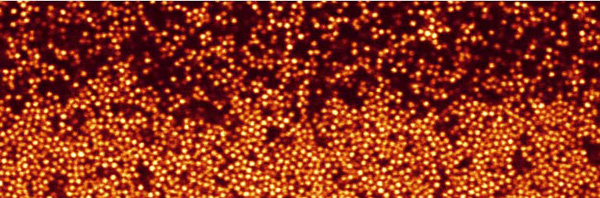
A colloidal gas-liquid interface. Picture by Paddy Royall.
If your particles are all the same size, you can even observe two consecutive jumps, from gas to liquid and then from liquid to crystal, where the particles are neatly aligned. Particles with different sizes would jumble the alignment. In general, it is quite difficult to make particles of different size crystallize.


There are several ways to get to this triple coexistence situation.  One possibility is that you first have the gas and the liquid that separate, and then the crystal forms from the liquid. A second possibility is crystals condensing from the liquid, settling down in sufficient quantities and only then does the liquid evaporates to form a gas layer on top. A third possibility is the crystals forming at the same time as gas bubbles, racing to the bottom or the top respectively. Only when gas and crystal layers sit on top of each other does some of the crystal melts to form a liquid layer in between.

My contribution was to add some more complexity to the first scenario. What if I add a few large particles (green) in the suspension of small particles (red) ?

At first, nothing changes: on top a gas that has almost no particle and on the bottom a mixture of many small and a few large particles.  If there was only small particles crystals would form at the bottom. But the large particles get in the way and no crystallisation occurs at the bottom.

Meanwhile the large particles settle faster than the small ones. So at the top of the liquid we soon have a layer devoid of large particles. Only small particles? Easy to make crystals then (big red blobs on the video below). Crystals are large, compact, and fall even faster than large particles. They outpace them and dive in the dense mixture of large and small particles. Splash!


And here we have something unexpected: the crystals float! I mean, yes, ice floats over water, we are accustomed to this. But water is an exception. Solid metal sink down into molten metal.
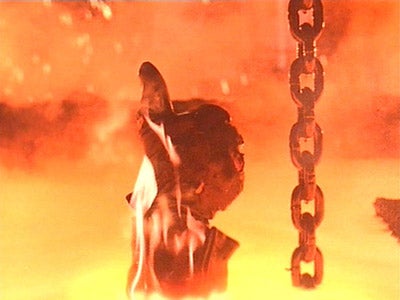

Actually we demonstrates that the mixture of small and large particles can get so dense without crystallizing that crystals made only of small particles can float in it.

The crystals are reasonably happy in there, not melting but not growing either. Since crystals are dropped continuously from the top, they end up filling pretty much the whole pool (where the large particles are) and even piling up over the level of the large particles.

Now the crystals that are over the level of the pool have no large particles to prevent their growth, so they grow and make a dense "ice pack" on top of the pool.

Final state of the limit between floating crystals (below) and the ice pack (above). This is the same place as the video above.


At the end, you get a pretty layered cake: gas on top, then a layer of liquid, then the ice pack, then the crystals made of small particles floating in the pool of large and small particles.

Details of the full layered sediment. Top: gas-liquid interface. Middle: ice pack. Bottom: crystals made of small particles in a small+large amorphous matrix.


Leocmach, M., Royall, C. P., & Tanaka, H. (2010). Novel zone formation due to interplay between sedimentation and phase ordering. EPL (Europhysics Letters), 89(3), 38006. doi:10.1209/0295-5075/89/38006
http://arxiv.org/abs/1402.0315


Saturday, March 17, 2012

Count on your neighbour

Counting how many stuff you have is important
Scrooge counting his money
... but boring
counting sheeps
During last week, I saw a few times one of my fellow lab member printing a picture like this
Phase contrast microscopy picture of nucleation
and putting a cross on each white object. He was counting them. The first time I saw this, I thought he had to do it for one or two pictures. But at the end of the week, I asked him what he was doing and if I could help.


The above picture is taken when a phase A nucleates into a phase B. This appends for example if you cool a liquid below it's crystallization temperature. A crystal nucleus will appear from time to time and grow. The probability to form a nucleus (nucleation rate) is a very important physical parameter: if nucleation is extremely rare, you will have a single nucleus in you bottle that will grow to form a single crystal before the birth of the next nucleus. This is exactly what you want for example when you make a silicon wafer for microelectronics. If nucleation rate is high, then you will have many nuclei growing at the same time and at the end a material that is made of many different crystals. You may want this in ice creams, because small crystals have a more pleasant texture than big ones.


The only method to measure the nucleation rate in a given system is to count the number of nuclei function of time. So my colleague was counting ... for the whole week. He had done two dozens of experiments at different temperatures and compositions, and took a series of picture for each (like every couple of second for a few minutes). This makes hundreds if not thousands of pictures to analyze. And his plan was to do it by hand.

Try to count how many nuclei are in the above picture. This is a task that need careful attention: large nuclei have a good contrast, but there are many smaller ones very difficult to tell from the background. That's why my colleague was printing and crossing the counted nuclei.

As I told you in a previous post, this kind of procedure can be fully automatized. The programming takes time, so if you have only a few pictures to analyze, this may not be a good idea. In addition, this counting is tricky because the objects can have very different sizes and contrasts. However I, sitting 3 steps away, had already developed and tested such a program. The physical signification is different (I am tracking polydisperse colloidal particles) but the technology is the same. So yes, I could help.

An hour later my colleague had in his computer a script counting the nuclei for him, a picture per second or less, automated to treat a whole time series automatically without human intervention. Setting-up Python and dependencies on his computer took half of the time. We should have communicated earlier, before he had spent a week doing what the script could do in an hour.

Result of the localization. Original image (red) superimposed with localized positions (cyan squares)
As you can see on the picture above, the result is not 100% perfect, but quite close. For example there are problems when nuclei are fusing and there are also (very few) centers counted multiple times. I think I know how to adapt better my program to this situation, but my colleague told me it was enough precision for him.

This gives an other motivation to explain (in a future post) how this counting/localizing method is working.

Wednesday, November 16, 2011

Particle tracking I : from analog to digital


Pinpointing the positions and sizes of tens of thousands particles from pictures. I can't miss one, I can't detect a particle where there is none. The precision must be extremely high. That is what I am doing routinely as the basis of my research. If I don't get this step right, my research has feet of clay, standing on sand.

In 1905 Einstein published three papers founding or revealing three different fields of physics : relativity, quantum mechanics and Brownian motion. The last one is a major breakthrough in statistical physics because if it was true, then matter was discontinuous, made of particles like atoms or molecules. However an experimental proof was needed.
Jean Baptiste Perrin

Jean Perrin exhibited this proof by the following experiments around 1908 : he suspended microscopic gamboge particles in water and waited for them to settle. Obviously their were more particles at the bottom than at the top ; however, how many more ? Perrin took a microscope and counted : how many particles do I see in average in a drop of suspension taken at 1 cm from the bottom (do it for 1000 drops to get a good average) ? How many at 2 cm ? etc. The concentration profile he got was perfectly fitting with theoretical predictions and thus discontinuity of matter was proved. Jean Perrin got the Nobel prize in physics 1926 for that.

A century later, how do you do track particles ? First, you don't need to stick your eye to a microscope. You take a digital picture with a CCD camera adapted to the microscope. Of course you can take movies.
A typical image of a dense colloidal suspension, taken by confocal microscope.
Now you have about ten thousand pictures like that out of a single experiment. Of course, you can superimpose the picture with a grid, locate the coordinates of a particle by following the grid with your finger, write them down in a notebook and so on and so forth. Perrin could have done that during years, but we have computer slaves.

Crocker and Grier designed the following algorithm to track individual particles from pictures. It is probably easier to understand if we imagine the intensity of each pixel as an altitude. For example, the two pictures below are equivalent.

Noisy picture of particles
Corresponding intensity profile
Blur your image to remove noise and to smooth the particles' intensity profile. Each particle should become a peak with no flatness at the top.

Previous picture, blurred


Find the pixels that are local intensity maxima. Their must be one per particle + others due to noise.
Local maxima


If you have large areas without particles, you may find local maxima there due to noise. If you remove the local maxima that are not bright enough, you should be left with only particles, none from noise. Now you know the coordinates of each particle centre with discreet (pixel) precision.
To increase the precision, you can take the centre of mass (intensity) of the pixels surrounding each possible centre. This gives subpixel resolution (about 1/10th of a pixel).

This is an extremely quick and efficient algorithm used routinely by many groups either in 2D or in 3D (yes, you can take 3D pictures, I'll have a post about it). You can check the official web page for more information. My own code for that is on sourceforge.

So far so good if your particles have the same size ... something that almost never append in nature, and not that often in experiments. I'll write about the more-than-one-size case in an other post.

Friday, November 11, 2011

Kanto softmatter talk

A busy week is ending ... almost. I give a talk tomorrow at a workshop (yes, a Saturday !), on Monday I submit a research proposal to be paid from April. And after that I will have to work again on a paper that has been rejected.

Tomorrow is the kanto softmatter workshop, a very local meeting for the soft matter labs around Tokyo. Talks are only given by young researchers, not by big names. That is why I have an opportunity to talk. In larger conferences until now I only got poster presentations. Well, there is no bed of roses.

I will talk about my thesis work, in particular the content of the paper that was rejected: what are the local structures playing a role in a model of glass transition and which one is more important than the other. The answer is rather surprising. A glass is amorphous, so most people think that a glass is the opposite of a crystal. Therefore if glass has a structure this structure must be very different and incompatible with the crystal symmetry. That's why icosahedral order is often exhibited as a typical glass order.

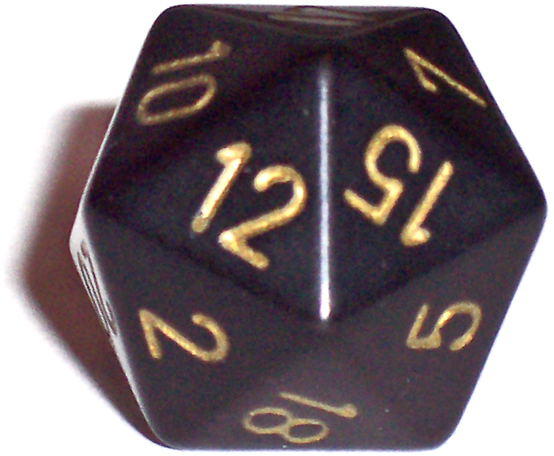
A icosahedron is a solid with 20 identical faces. Like this dice used in Dungeons&Dragons.
via Wikimedia
13 particles forming a perfect icosahedron, from my thesis
As you can see, there are pentagons everywhere in that structure: icosahedron has 5-fold symmetries. The problem with five-fold symmetry is that it cannot pave space (at least in 2D and 3D). Try to pack them together and you will always have gaps.
By JF Sadoc via Wikimedia

However, the icosahedron is very dense and often maximises locally the interaction energy between the particles. Icosahedral order is locally the best structure, so it forms easily in a dense liquid, but cannot spread. That is what is called frustration.

What one can image in a supercooled liquid is icosahedral bits, probably forming a sort of network or fractal, and total disorder in the gaps. The icosahedral structure is stable, so is moves very slowly and slows the overall dynamics. If we are still in the liquid a given icosahedral bit will eventually disappears while order is formed elsewhere, but in the glass even that rearrangement is forbidden, too costly in energy to append in a reasonable time, so everything is stuck. Here is an explanation of the glass transition.

Another explanation (advertise by my boss, so my judgement may be biased) is that a supercooled liquid is by definition metastable to the crystal, so the liquids "wants" to become a crystal. Things are getting in the way (like icosahedron for example) so the crystal is not formed. However, there are stuffs in the supercooled liquid that look like a little bit like crystals. Not very healthy crystal if you pass me the expression; hunchbacks, twisted legs, broken faces, no arms ... still if you look close enough the local structure is closer to the crystal than anything else.
a) displacements b) crystalline order and c) number of neighbours in a 2D shaken granular supercooled fluid. From Keiji Watanabe and Hajime Tanaka,
Physical Review Letters (2008).
Once you have a method to detect these crystal-like stuffs, which has been done in an handful of models, you discover that they are slower than the rest of the liquid and that their size is growing when you get closer to the glass transition. Paradoxically isn't it the crystal that is responsible for the slowing down to the glass ?

Who is slowing down the system ? The locally favoured structure of the fluid or the influence of the crystal ? To answer this question I used a system that has independently icosahedra and crystal-like structures. In a few systems, people have found very slow icosahedral structures and some of them exhibited it as the proof that liquid order was the culprit. However others remarked that the "crystal" in these systems actually contains some icosahedral motifs. For example if the "crystal" is in fact a quasicrystal with five-fold symmetry, you cannot tell if the icosahedra that you see in the supercooled liquid come from the locally favoured structure of the liquid or as crystal-like stuff.
A Frank-Kasper phase, which is a crystal containing icosahedra (large blue spheres). From the Trebin lab in the university of Stuttgart.
A quasicrystal with icosahedral symmetry, via Wikimedia


To avoid that confusion, my system has a well known crystal of face centered cubic structure, without a glimpse of icosahedron in it. In addition, icosahedral order is locally favoured. In that situation, no mistake possible, the slower structure wins.

And at the end, I found that the icosahedral bits play very little role in the slowing down, the crystal-like bits are doing all the slowing work. Of course Icosahedral order plays a role : it is frustrating the crystallisation, and that is thanks to that frustration that we are able to supercool the liquid in the first place. However, that is the influence of the crystal that governs the slowing down and thus the glass transition.

Details in the paper to come ... when accepted.

Tuesday, November 1, 2011

PhD pre-defence training

At the end of this week one of my fellow lab member will know if he is able to write his PhD thesis. In our university this is probably the most decisive step in the process of getting a PhD.

How you get a PhD varies tremendously between countries, universities within the same country and sometimes even between departments within the same university. For example, in the US it is not uncommon to spend between 7 and 10 years in graduate school before getting the PhD. In France the distinction between undergraduate and graduate is fuzzy, but the line between Master and PhD is not: you need at least 3 years of PhD, often a few months more in science and a few years more in humanities. Here in Japan and in science/engineering departments the rules is 2 years of Master and 3 years of PhD. The PhD defence season is also tightly constrained modulo 6 months, so actually almost everybody abides by this 2+3 years minimum.

The fellow I am writing about has a quite unusual curriculum. He took a job in the industry after graduating from his Master, got sick of it and came back to the academia at the same time I was starting my PhD (the 3 last years). He had personal problems on the way and extended his PhD to 4 years. According to the training I attended on Monday, he will surely get his PhD with honours.

Defending a thesis is a rather formal - some would say "outdated" - ceremonial. It also depends a lot on the country/university. I heard that in the university of Utrecht in the Netherlands the candidate and the jury are dressed in 16-17th century outfits, family is invited and you never fail at your defence, neither do you get nasty questions. If you fail, that's before.
A PhD candidate in Utrecht
In France the dress code is less formal, but the jury can push you quite hard the D day. One of my friends in Belgium had to re-write his thesis after an inconclusive defence and defend it again a few month later.

Here in Japan everything is made to avoid last moment failure, thanks to a pre-defence. It's not a training strictly speaking. You are in front of the same jury as for the real defence, but it is before you wrote a single line of your thesis. You pack up everything you did in the last 2 years and a half into a 1h talk. The jury knows nothing of your work beforehand except the title and probably a short abstract. You don't want to obfuscate their minds or they tend to sleep. You don't want to appear shallow or you won't be able to write your thesis now. So you need to be ready, trained and mentored.

This is the decisive step. After that, you do your best to write your thesis, probably patch a few missing experiments/simulations/analysis, re-do everything just in case, etc. This easily eats the remaining 2 or 3 month before handing out the thesis, but the essential part is done. If you don't blow up during theses weeks of intense pressure and self-discouragement (I nearly did, but I was save by my family), you are done. You won't fail the D day anyway.

This fellow is going through the fire on Friday. His rehearsal on Monday was excellent (there were a few minor details to fix, but nothing important). Good luck.