At the beginning of June, I had the pleasure to attend my first conference about food science: The 7th International Symposium on Food Rheology and Structure.
I love food, my family loves food. With my sisters and brother we talk about food almost each time we meet. My aunts and uncles do the same. We love making food for each others and for our guests. My wife has the same kind of sensibility.
I love food, I love to cook. I love to improvise a new dish. I have dozens of spices in my kitchen, and I try to master their use, alone or in combination. I became versed in some recipes, likes lasagne bolognese, but I take on new challenges as often as possible. I often knead pasta or udon, I made chocolate éclair when they were impossible to find in Tokyo.
I love food, I love to understand it. My scientist brain can't be turned off when I cook. Mayonnaise is an emulsion, flour a granular material. When I make white sauce, the size of the eddies generated by my spoon is a visual indication of the Reynolds number and thus the viscosity of the sauce undergoing a sol-gel transition. Boiling water is a thermostat at 100°C.
I love food, I study it. My first independent project as an undergrad was about mayonnaise. Then I learned that soft matter science was a thing and went up to the PhD studying rather inedible soft materials. Freshly arrived in France as a postdoc, my new boss asked me if I wanted to study "waxy crude oil" or yoghurt. Of course I chose the later. I studied it as a physicist during 3 years and now finally I was able to present my results to food scientists.
I love food, but I am not a food scientist. I am not trying to formulate a new yoghurt. I don't make the link between the mouth feel adjectives rated by a panel of trained consumers and mechanical measurements. I am more interested by the physics that it reachable through the study of food systems.
I love food, and it was a pleasure to meet the food science community. I discovered very interesting systems, I heard interesting questions being raised, I received nice feedbacks about my contribution (see below). I even met a reader of this blog, hello Dilek!
I love food, I will meet this community again. I have been invited to Journées Scientifiques sur le thème Matière Molle pour la Science des Aliments, a conference to unite the French food science community. It will be held in October 28-29 in Montpellier.
Showing posts with label conference. Show all posts
Showing posts with label conference. Show all posts
Wednesday, July 15, 2015

Saturday, December 17, 2011
Unifiying conference
I am frustrated when I cannot go to an international conference once a year. But at the end of it I am worn out. Usually it lasts a week. This time it was two weeks in a row. I wonder how I am still able to think.
International scientific conference are at the heart of the research world, at least as important as scientific publications. Without conferences, you would not know who is working in your field. That is where you discover that paper authors are not only names but human beings. Dr. X who is contradicting your results is actually a very friendly guy an the best person to chat to or to go to restaurant with. Pr. Y whose intuitions are always stunningly genial can be a frightening freak, a reckless egocentric or ... a very seducing man/woman.
There are the personalities you discover and the ones you are eager to meet again. From conferences to conferences the bonds tighten (often despite the scientific disagreements) and from these irregular contacts emerges a community, a human community closely related to the abstract "scientific community".
But scientific conferences are not only a bunch of old chaps meeting once a year. This is a powerful way to exchange ideas and to be able to dig into what other researchers have discovered. If you have read someone's paper, you are able to ask him/her questions to clarify and discuss his/her work. If not, hearing his/her presentation may make you read the referring article.
In practice, a conference consists in a series of oral presentations of various lengths. Typically a researcher invited by the organisers will have an hour to expose his/her research in front of everybody, a researcher selected by the organisers will have 30 minutes, and the others will have only a poster presentation. I am at the poster level, so I stuff my results on a A0 that I hang in the dedicated place off the conference hall and during the so called "poster session" time I stand by, ready to explain my work to anybody interested. This also implies some advertising skill beforehand.
Except your short time under the spotlight (your talk or your poster session), the conference consists mainly in listening to other's stories. In the past week I have listen to 8-10 talks every day, each representing at least months and more probably years of work condensed in 30 minutes or an hour. The previous week was more like 6 talks a day. Anyway, this is an enormous amount of information, a all you can eat buffet that I will slowly digest from now on.
I will probably post here in the future some reflexions or discussions that result from this conference.
International scientific conference are at the heart of the research world, at least as important as scientific publications. Without conferences, you would not know who is working in your field. That is where you discover that paper authors are not only names but human beings. Dr. X who is contradicting your results is actually a very friendly guy an the best person to chat to or to go to restaurant with. Pr. Y whose intuitions are always stunningly genial can be a frightening freak, a reckless egocentric or ... a very seducing man/woman.
There are the personalities you discover and the ones you are eager to meet again. From conferences to conferences the bonds tighten (often despite the scientific disagreements) and from these irregular contacts emerges a community, a human community closely related to the abstract "scientific community".
But scientific conferences are not only a bunch of old chaps meeting once a year. This is a powerful way to exchange ideas and to be able to dig into what other researchers have discovered. If you have read someone's paper, you are able to ask him/her questions to clarify and discuss his/her work. If not, hearing his/her presentation may make you read the referring article.
In practice, a conference consists in a series of oral presentations of various lengths. Typically a researcher invited by the organisers will have an hour to expose his/her research in front of everybody, a researcher selected by the organisers will have 30 minutes, and the others will have only a poster presentation. I am at the poster level, so I stuff my results on a A0 that I hang in the dedicated place off the conference hall and during the so called "poster session" time I stand by, ready to explain my work to anybody interested. This also implies some advertising skill beforehand.
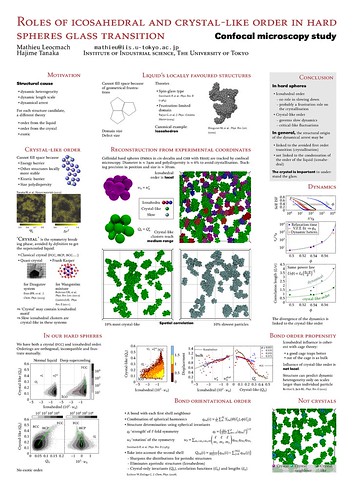 |
| My poster for Unifying Concepts in Glass Physics 2011 |
I will probably post here in the future some reflexions or discussions that result from this conference.
Sunday, November 27, 2011
Seminar and meetings in France
I'm giving a seminar in the Ecole Normale Supérieure (ENS) in Lyon, France the 6th of December. Just after that I'll be in Paris for 2 consecutive meetings:
- The French-Japanese meeting on Jamming, Glasses and Phase transitions
- Unifying Concepts in Glass Physics V, where I will be presenting a poster.
A link between local structural ordering and slow dynamics has recently attracted much attention from the context of the origin of glassy slow dynamics [1, 2]. There have been a few candidates for such structural order [3, 4], icosahedral order, exotic amorphous order, and crystal-like order. Each type of order is linked to a different scenario of glass transition. Thus, revealing the order responsible for slow dynamics is crucial for our understanding of the glass transition. Here we experimentally access local structural order in polydisperse hard spheres by its particle-level observation with confocal microscopy. We identify the key structures as icosahedral and face-centred-cubic(fcc)-like order, excluding any other simple local symmetry. We find that both types of order are statistically associated with slow particles. However, when approaching the glass transition, the icosahedral order does not grow in size whereas crystal-like structures grow. It is the latter that governs the dynamics and is linked to dynamic heterogeneity. This questions the direct roles of the icosahedral ordering in glassy slow dynamics and stresses the importance of the structural order compatible with the avoided first order transition, crystallization. Our finding also suggests that the growing lengthscale of structural order is essential for the slowing down of dynamics and the nonlocal cooperativity in particle motion.
References
- Cavagna, A. Supercooled liquids for pedestrians. Physics Reports 476, 51124, 2009.
- Berthier, L. & Biroli, G. Theoretical perspective on the glass transition and amorphous materials. Rev. Mod. Phys. 83, 587, 2011.
- Steinhardt, P., Nelson, D. & Ronchetti, M. Bond-orientational order in liquids and glasses. Phys. Rev. B 28, 784805, 1983.
- Tarjus, G., Kivelson, S. A., Nussinov, Z. & Viot, P. The frustration-based approach of super-cooled liquids and the glass transition: a review and critical assessment. J. Phys.: Condens. Matter 17, R114R1182, 2005.
- Lubchenko, V. & Wolynes, P. Theory of structural glasses and supercooled liquids. Annu. Rev. Phys. Chem. 58, 235266, 2007.
- Tanaka, H., Kawasaki, T., Shintani, H. & Watanabe, K. Critical-like behaviour of glass-forming liquids. Nature materials 9, 324Ð31, 2010.
 |
| Reconstruction from confocal microscopy coordinates. Only structured particles are shown for clarity. |
Friday, November 11, 2011
Kanto softmatter talk
A busy week is ending ... almost. I give a talk tomorrow at a workshop (yes, a Saturday !), on Monday I submit a research proposal to be paid from April. And after that I will have to work again on a paper that has been rejected.
Tomorrow is the kanto softmatter workshop, a very local meeting for the soft matter labs around Tokyo. Talks are only given by young researchers, not by big names. That is why I have an opportunity to talk. In larger conferences until now I only got poster presentations. Well, there is no bed of roses.
I will talk about my thesis work, in particular the content of the paper that was rejected: what are the local structures playing a role in a model of glass transition and which one is more important than the other. The answer is rather surprising. A glass is amorphous, so most people think that a glass is the opposite of a crystal. Therefore if glass has a structure this structure must be very different and incompatible with the crystal symmetry. That's why icosahedral order is often exhibited as a typical glass order.
A icosahedron is a solid with 20 identical faces. Like this dice used in Dungeons&Dragons.
As you can see, there are pentagons everywhere in that structure: icosahedron has 5-fold symmetries. The problem with five-fold symmetry is that it cannot pave space (at least in 2D and 3D). Try to pack them together and you will always have gaps.
However, the icosahedron is very dense and often maximises locally the interaction energy between the particles. Icosahedral order is locally the best structure, so it forms easily in a dense liquid, but cannot spread. That is what is called frustration.
What one can image in a supercooled liquid is icosahedral bits, probably forming a sort of network or fractal, and total disorder in the gaps. The icosahedral structure is stable, so is moves very slowly and slows the overall dynamics. If we are still in the liquid a given icosahedral bit will eventually disappears while order is formed elsewhere, but in the glass even that rearrangement is forbidden, too costly in energy to append in a reasonable time, so everything is stuck. Here is an explanation of the glass transition.
Another explanation (advertise by my boss, so my judgement may be biased) is that a supercooled liquid is by definition metastable to the crystal, so the liquids "wants" to become a crystal. Things are getting in the way (like icosahedron for example) so the crystal is not formed. However, there are stuffs in the supercooled liquid that look like a little bit like crystals. Not very healthy crystal if you pass me the expression; hunchbacks, twisted legs, broken faces, no arms ... still if you look close enough the local structure is closer to the crystal than anything else.
Once you have a method to detect these crystal-like stuffs, which has been done in an handful of models, you discover that they are slower than the rest of the liquid and that their size is growing when you get closer to the glass transition. Paradoxically isn't it the crystal that is responsible for the slowing down to the glass ?
Who is slowing down the system ? The locally favoured structure of the fluid or the influence of the crystal ? To answer this question I used a system that has independently icosahedra and crystal-like structures. In a few systems, people have found very slow icosahedral structures and some of them exhibited it as the proof that liquid order was the culprit. However others remarked that the "crystal" in these systems actually contains some icosahedral motifs. For example if the "crystal" is in fact a quasicrystal with five-fold symmetry, you cannot tell if the icosahedra that you see in the supercooled liquid come from the locally favoured structure of the liquid or as crystal-like stuff.
To avoid that confusion, my system has a well known crystal of face centered cubic structure, without a glimpse of icosahedron in it. In addition, icosahedral order is locally favoured. In that situation, no mistake possible, the slower structure wins.
And at the end, I found that the icosahedral bits play very little role in the slowing down, the crystal-like bits are doing all the slowing work. Of course Icosahedral order plays a role : it is frustrating the crystallisation, and that is thanks to that frustration that we are able to supercool the liquid in the first place. However, that is the influence of the crystal that governs the slowing down and thus the glass transition.
Details in the paper to come ... when accepted.
Tomorrow is the kanto softmatter workshop, a very local meeting for the soft matter labs around Tokyo. Talks are only given by young researchers, not by big names. That is why I have an opportunity to talk. In larger conferences until now I only got poster presentations. Well, there is no bed of roses.
I will talk about my thesis work, in particular the content of the paper that was rejected: what are the local structures playing a role in a model of glass transition and which one is more important than the other. The answer is rather surprising. A glass is amorphous, so most people think that a glass is the opposite of a crystal. Therefore if glass has a structure this structure must be very different and incompatible with the crystal symmetry. That's why icosahedral order is often exhibited as a typical glass order.
A icosahedron is a solid with 20 identical faces. Like this dice used in Dungeons&Dragons.
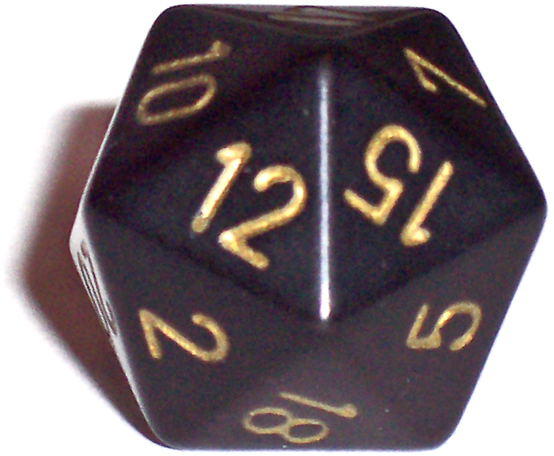 |
| via Wikimedia |
 |
| 13 particles forming a perfect icosahedron, from my thesis |
 |
| By JF Sadoc via Wikimedia |
However, the icosahedron is very dense and often maximises locally the interaction energy between the particles. Icosahedral order is locally the best structure, so it forms easily in a dense liquid, but cannot spread. That is what is called frustration.
What one can image in a supercooled liquid is icosahedral bits, probably forming a sort of network or fractal, and total disorder in the gaps. The icosahedral structure is stable, so is moves very slowly and slows the overall dynamics. If we are still in the liquid a given icosahedral bit will eventually disappears while order is formed elsewhere, but in the glass even that rearrangement is forbidden, too costly in energy to append in a reasonable time, so everything is stuck. Here is an explanation of the glass transition.
Another explanation (advertise by my boss, so my judgement may be biased) is that a supercooled liquid is by definition metastable to the crystal, so the liquids "wants" to become a crystal. Things are getting in the way (like icosahedron for example) so the crystal is not formed. However, there are stuffs in the supercooled liquid that look like a little bit like crystals. Not very healthy crystal if you pass me the expression; hunchbacks, twisted legs, broken faces, no arms ... still if you look close enough the local structure is closer to the crystal than anything else.
 |
| a) displacements b) crystalline order and c) number of neighbours in a 2D shaken granular supercooled fluid. From Keiji Watanabe and Hajime Tanaka, Physical Review Letters (2008). |
Who is slowing down the system ? The locally favoured structure of the fluid or the influence of the crystal ? To answer this question I used a system that has independently icosahedra and crystal-like structures. In a few systems, people have found very slow icosahedral structures and some of them exhibited it as the proof that liquid order was the culprit. However others remarked that the "crystal" in these systems actually contains some icosahedral motifs. For example if the "crystal" is in fact a quasicrystal with five-fold symmetry, you cannot tell if the icosahedra that you see in the supercooled liquid come from the locally favoured structure of the liquid or as crystal-like stuff.
 |
| A Frank-Kasper phase, which is a crystal containing icosahedra (large blue spheres). From the Trebin lab in the university of Stuttgart. |
 |
| A quasicrystal with icosahedral symmetry, via Wikimedia |
To avoid that confusion, my system has a well known crystal of face centered cubic structure, without a glimpse of icosahedron in it. In addition, icosahedral order is locally favoured. In that situation, no mistake possible, the slower structure wins.
And at the end, I found that the icosahedral bits play very little role in the slowing down, the crystal-like bits are doing all the slowing work. Of course Icosahedral order plays a role : it is frustrating the crystallisation, and that is thanks to that frustration that we are able to supercool the liquid in the first place. However, that is the influence of the crystal that governs the slowing down and thus the glass transition.
Details in the paper to come ... when accepted.
Subscribe to:
Posts (Atom)