Showing posts with label people. Show all posts

Saturday, December 17, 2011

Unifiying conference

I am frustrated when I cannot go to an international conference once a year. But at the end of it I am worn out. Usually it lasts a week. This time it was two weeks in a row. I wonder how I am still able to think.

International scientific conference are at the heart of the research world, at least as important as scientific publications. Without conferences, you would not know who is working in your field. That is where you discover that paper authors are not only names but human beings. Dr. X who is contradicting your results is actually a very friendly guy an the best person to chat to or to go to restaurant with. Pr. Y whose intuitions are always stunningly genial can be a frightening freak, a reckless egocentric or ... a very seducing man/woman.

There are the personalities you discover and the ones you are eager to meet again. From conferences to conferences the bonds tighten (often despite the scientific disagreements) and from these irregular contacts emerges a community, a human community closely related to the abstract "scientific community".

But scientific conferences are not only a bunch of old chaps meeting once a year. This is a powerful way to exchange ideas and to be able to dig into what other researchers have discovered. If you have read someone's paper, you are able to ask him/her questions to clarify and discuss his/her work. If not, hearing his/her presentation may make you read the referring article.

In practice, a conference consists in a series of oral presentations of various lengths. Typically a researcher invited by the organisers will have an hour to expose his/her research in front of everybody, a researcher selected by the organisers will have 30 minutes, and the others will have only a poster presentation. I am at the poster level, so I stuff my results on a A0 that I hang in the dedicated place off the conference hall and during the so called "poster session" time I stand by, ready to explain my work to anybody interested. This also implies some advertising skill beforehand.
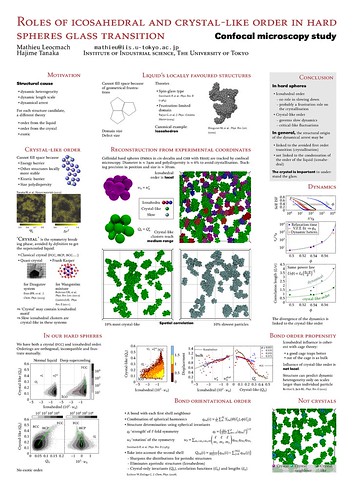
My poster for Unifying Concepts in Glass Physics 2011
Except your short time under the spotlight (your talk or your poster session), the conference consists mainly in listening to other's stories. In the past week I have listen to 8-10 talks every day, each representing at least months and more probably years of work condensed in 30 minutes or an hour. The previous week was more like 6 talks a day. Anyway, this is an enormous amount of information, a all you can eat buffet that I will slowly digest from now on.

I will probably post here in the future some reflexions or discussions that result from this conference.

Tuesday, November 1, 2011

PhD pre-defence training

At the end of this week one of my fellow lab member will know if he is able to write his PhD thesis. In our university this is probably the most decisive step in the process of getting a PhD.

How you get a PhD varies tremendously between countries, universities within the same country and sometimes even between departments within the same university. For example, in the US it is not uncommon to spend between 7 and 10 years in graduate school before getting the PhD. In France the distinction between undergraduate and graduate is fuzzy, but the line between Master and PhD is not: you need at least 3 years of PhD, often a few months more in science and a few years more in humanities. Here in Japan and in science/engineering departments the rules is 2 years of Master and 3 years of PhD. The PhD defence season is also tightly constrained modulo 6 months, so actually almost everybody abides by this 2+3 years minimum.

The fellow I am writing about has a quite unusual curriculum. He took a job in the industry after graduating from his Master, got sick of it and came back to the academia at the same time I was starting my PhD (the 3 last years). He had personal problems on the way and extended his PhD to 4 years. According to the training I attended on Monday, he will surely get his PhD with honours.

Defending a thesis is a rather formal - some would say "outdated" - ceremonial. It also depends a lot on the country/university. I heard that in the university of Utrecht in the Netherlands the candidate and the jury are dressed in 16-17th century outfits, family is invited and you never fail at your defence, neither do you get nasty questions. If you fail, that's before.
A PhD candidate in Utrecht
In France the dress code is less formal, but the jury can push you quite hard the D day. One of my friends in Belgium had to re-write his thesis after an inconclusive defence and defend it again a few month later.

Here in Japan everything is made to avoid last moment failure, thanks to a pre-defence. It's not a training strictly speaking. You are in front of the same jury as for the real defence, but it is before you wrote a single line of your thesis. You pack up everything you did in the last 2 years and a half into a 1h talk. The jury knows nothing of your work beforehand except the title and probably a short abstract. You don't want to obfuscate their minds or they tend to sleep. You don't want to appear shallow or you won't be able to write your thesis now. So you need to be ready, trained and mentored.

This is the decisive step. After that, you do your best to write your thesis, probably patch a few missing experiments/simulations/analysis, re-do everything just in case, etc. This easily eats the remaining 2 or 3 month before handing out the thesis, but the essential part is done. If you don't blow up during theses weeks of intense pressure and self-discouragement (I nearly did, but I was save by my family), you are done. You won't fail the D day anyway.

This fellow is going through the fire on Friday. His rehearsal on Monday was excellent (there were a few minor details to fix, but nothing important). Good luck.